

Bulk Servo Motor Magnets Essential Guide for High Performance Applications
2026-09-06
Servo motors are only as good as the magnets hiding inside their rotors—and when you're ordering in bulk, one weak batch can ripple through your entire production line. This guide cuts through the noise to show what actually matters for high-performance applications: magnetic flux density, thermal resilience, and batch-to-batch consistency. Whether you're upgrading a factory line or designing precision robotics, sourcing from a partner like DAWA can mean the difference between hitting your torque targets or eating the cost of rework.
Magnet Material Choices That Actually Change Torque Density
The torque density of a permanent magnet motor scales almost linearly with the air-gap flux density, which is set by the remanence (Br) of the magnet material. Neodymium-iron-boron (NdFeB) grades like N42 or N52 push Br to 1.3–1.45 T, giving you the highest flux per pole and the most compact motor envelope for a given torque target. Ferrite magnets sit far below that, typically around 0.4 T, so you would need roughly three times the magnet cross-section to achieve a comparable flux—often cancelling out any cost or weight advantage in torque-dense applications. SmCo lands in between with Br near 1.0–1.1 T, but its real value shows up under thermal stress, not in a room-temperature datasheet comparison.
What gets overlooked is how coercivity and temperature coefficients reshape that simple Br ranking once the motor runs hot. Standard NdFeB can lose a meaningful share of its flux at 120–150°C unless you select a high-coercivity grade with heavy rare earth additions, which raises cost and may still fall short of SmCo’s stability. In a traction motor or aerospace actuator where the winding temperature routinely exceeds 150°C, switching from N42 to a samarium-cobalt grade like Sm2Co17 can actually preserve more torque density at operating temperature, even though the SmCo’s cold performance looks lower on paper. The magnet that wins the datasheet contest is not always the one that delivers torque after heat soak.
The practical takeaway is that magnet material choice and rotor geometry must be co-designed. If you are forced into ferrite for cost or supply chain reasons, a spoke-type rotor or flux-concentrating arrangement can partially recover the lost torque density, but the motor grows in diameter and mass. Conversely, a high-Br NdFeB magnet may allow a thinner magnet and smaller air gap, but it demands careful thermal management and possibly a segmented design to limit eddy-current losses. Choosing a magnet purely by its energy product ignores how the machine will actually build torque across the full speed and temperature range.
Reading Between the Lines of Remanence and Coercivity Specs
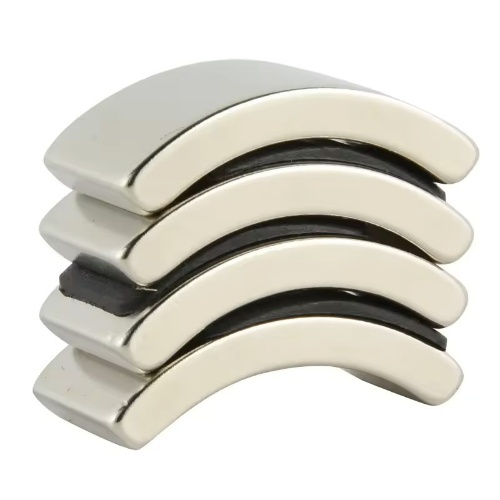
Magnet datasheets often list remanence (Br) and coercivity (Hc or Hci) as if they were standalone properties, but the real meaning only emerges once you consider the measurement setup. Br is usually reported for a closed magnetic circuit, which eliminates self-demagnetization. In an open-circuit application, the working flux density is far lower, and a high Br value alone won't tell you much about actual performance unless you account for the magnet's length-to-diameter ratio or the presence of nearby soft iron.
Coercivity specs can mislead in a different way. The number printed may be intrinsic coercivity (Hci), which indicates resistance to demagnetization, while normal coercivity (Hc) describes the field needed to reduce flux density to zero in a fully magnetized material. If you mix these up when comparing grades, you might select a magnet that demagnetizes under elevated temperature or a reverse field, even though the datasheet looked impressive at room temperature.
A more useful approach is to examine the full second-quadrant B-H curve rather than a single pair of values. The shape of the knee, the temperature coefficient of Hci, and the slope around the operating point often reveal whether a material will hold up in a motor, sensor, or holding fixture. Manufacturers sometimes highlight only room-temperature minimums, but a modest dip in Hci at 80°C or 120°C can turn a seemingly safe design into a field failure.
Why Magnet Tolerances Make or Break Air Gap Performance
In any magnetic assembly, the air gap is the narrow space where flux jumps from one pole to another, and its dimensions dictate how much usable field reaches the working zone. Magnet tolerances directly control this gap because even a few hundredths of a millimeter variation in magnet thickness or flatness alters the physical distance between the magnet face and the opposing steel. A thicker-than-nominal magnet squeezes the gap, pushing flux density higher than the design target; a thinner one widens it and lets field strength sag. Unlike electromagnetic coils, where current can be adjusted to compensate, permanent magnets have no such dial to turn—once the parts are assembled, the gap is whatever the tolerance stack-up creates.
The problem compounds when multiple magnets sit side by side on a rotor or linear track. If one magnet is a few microns proud of its neighbor, the air gap becomes uneven across the surface. This non-uniformity forces the flux to crowd through the narrower regions, creating localized saturation and magnetic hot spots. In a motor, that translates into cogging torque, increased vibration, and acoustic noise that no amount of electronic tuning can fully erase. Even worse, the high spots attract more magnetic pull, which can accelerate bearing wear or cause the rotor to drift off-center, further degrading the gap geometry. What began as a trivial dimensional deviation becomes a self-reinforcing performance loss.
Manufacturers often try to mask loose magnet tolerances by increasing the nominal air gap, hoping a larger average distance will swallow the variations. But this strategy throws away flux density across the board—you end up with a device that runs smoothly but delivers far less torque or holding force than the magnet material is capable of. A better approach is to tighten tolerances on magnet thickness, parallelism, and surface finish, then design the assembly with a small but consistent gap. When every magnet fits the same way, the air gap becomes a predictable, uniform channel for flux rather than a lottery. That predictability is what separates a reliable, high-efficiency magnetic system from one that merely works on paper.
Heat, Demagnetization, and the Grade Selection Sweet Spot
Raising the operating temperature of a permanent magnet is rarely a gentle affair. Most grades start to lose magnetic strength long before they reach their formal maximum working temperature, and the decline can be irreversible if the heat pushes into the knee of the demagnetization curve. What makes this tricky is that the loss isn't always linear: a few degrees beyond a critical threshold can knock a magnet down by 10 or 15 percent, while another ten degrees might only shave off a fraction. Engineers who assume that a higher-temperature grade is always the safe choice often overlook how the shape of the B-H curve changes under load, especially in motors or generators where the magnet faces a strong opposing field.
This is where grade selection stops being a simple spec-sheet comparison and becomes a balancing act. A magnet rated for 180°C may hold its coercivity beautifully, but it might also deliver lower remanence at room temperature than a cheaper grade that would have survived the actual duty cycle. The sweet spot is usually found by mapping the worst-case temperature spike, the duration of exposure, and the exact demagnetizing field the magnet will see in service. In many cases, a mid-range grade with a slightly higher intrinsic coercivity—rather than a top-tier grade with excessive thermal margin—provides the best combination of performance, cost, and reliability. The key is to test the magnet at the real operating point, not just the headline temperature limit.
Suppliers that understand this will often recommend a grade that sits just above the knee of the demagnetization curve at peak temperature, with a small safety buffer. That buffer matters because manufacturing variation and localized hot spots can push a magnet closer to the edge than a thermal simulation might suggest. Yet going too far up the grade ladder adds cost without meaningful benefit, and in some cases can reduce the flux output enough to force a larger magnet volume. The truly optimized design uses heat and demagnetization data to pick a grade that survives the worst realistic condition while leaving just enough margin for surprises—no more, no less.
Coatings and Corrosion: The Overlooked Lifespan Multiplier
Corrosion rarely announces itself with dramatic failures; it works quietly, thinning pipe walls and pitting structural steel. What many asset owners overlook is that a well-chosen coating system doesn't just slow this process—it can multiply the functional life of a component several times over. The problem is that coatings are often treated as a cosmetic afterthought rather than a core engineering control.
Modern protective coatings do much more than cover metal. They act as barrier layers, but also incorporate inhibitors that neutralize corrosive ions at the interface. Some formulations are designed to sacrifice themselves preferentially, while others flex with thermal expansion to avoid microcracking. This means the right coating can stop localized corrosion before it starts, preserving load-bearing capacity and preventing the kind of hidden degradation that leads to sudden, expensive replacements.
The overlooked part is how this translates into lifespan economics. A structure designed for a 20-year service life can easily reach 50 or 60 years if the coating is maintained on a sensible schedule. Conversely, skipping recoating to save short-term cost often forces early steel replacement, which consumes far more resources and downtime. Coatings are not just paint; they are a multiplier that determines whether an asset quietly outlives its design life or fails long before it.
Batch Consistency Checks Before You Commit to a Bulk Order
Before you commit to a bulk order, the biggest risk isn't just the unit price or the lead time—it's that what you approved in the sample might not be what actually shows up in the container. Batch consistency checks are the bridge between a promising prototype and a repeatable production run. Ask your supplier to document the exact raw material lots, dye formulations, or mold parameters used for the pre-production samples, then confirm those same specs will be locked for the bulk run. That single step can reveal whether the factory treats your sample as a one-off or as a true production standard.
A hands-on way to do this is to request a small batch pulled from the actual production line, not the R&D bench. Compare that batch against your reference sample under the same lighting and measurement conditions. Pay attention to subtle drift—gloss level, thread tension, edge finishing, mixed material density—that tends to change when a factory speeds up output. If anything falls outside your agreed tolerance, now is the moment to correct it, before huge quantities get cut, molded, or packed.
Finally, set a clear approval gate: no bulk production starts until you sign off on a batch consistency report that lists the tested parameters, the equipment used, and the operator's name. That report becomes your incoming quality baseline later, so you're not relying on memory when the shipment lands.
FAQ
In high-performance servo motors, magnet consistency and magnetic field uniformity matter more than raw pull strength. Engineers should request full BH curve data for each production lot, not just a generic grade number. Check for minimal flux variation across a batch—ideally under 2%—because even small deviations create cogging and torque ripple. Also confirm the supplier can hold mechanical tolerances within ±0.05 mm, since stack-up errors in rotor assemblies amplify vibration. Thermal stability at the motor's peak operating temperature is another non-negotiable; ask for irreversible loss data after exposure to 150°C or the application's ceiling, not just room-temperature specs.
Robotic joints rely on precise motion control, and the air gap between rotor magnets and stator is often only a fraction of a millimeter. If magnet thickness or arc radius varies by more than a few hundredths of a millimeter, the magnetic flux density shifts unevenly, causing the servo to hunt or overshoot. Tight tolerances also prevent mechanical imbalance at high RPM, which would otherwise shorten bearing life and introduce positional error. In collaborative robots, even acoustic noise from slight magnet misalignment can be a problem because it interferes with force sensing.
Neodymium grades like N42SH or N48UH can handle up to 150°C or 180°C, but they usually need heavy coatings and may still lose a few percent of flux after repeated thermal cycling. Samarium cobalt, while more brittle and costly, holds its magnetic properties almost flat up to 300°C and resists demagnetization far better in hot spots. For continuous-duty servo motors in aerospace or downhole tools, samarium cobalt often wins despite the price premium. For most industrial robots and CNC spindles, high-grade neodymium with proper cooling is sufficient and offers higher energy density per volume.
Coatings are the first line of defense against oxidation and galvanic corrosion, especially for neodymium magnets that contain reactive iron. In a servo motor, moisture ingress or aggressive cutting fluids can quickly turn uncoated magnets into rust powder, degrading the magnetic circuit. Epoxy coatings work for dry indoor environments, but nickel-copper-nickel or PTFE-based coatings are better for washdown or marine applications. The coating also affects friction during press-fit assembly—too thick or uneven a layer can chip and expose the base material. A quality supplier will test coating adhesion with thermal shock and salt spray, not just visual inspection.
Yes, but only with a supplier that uses statistical process control rather than sorting after production. Bulk orders let you lock in a specific magnet grade and coating spec, but the real savings come from reduced setup time and lower per-unit inspection costs. Ask for a capability study showing Cp and Cpk values for key dimensions and flux output over at least 30 lots. Avoid spot-buying from brokers who mix batches—magnet properties vary enough between melts that you can end up with rotor imbalances and unpredictable torque constants. Long-term contracts with a single magnet manufacturer also help stabilize raw material surcharges.
For precision motion, look beyond maximum energy product. The knee point of the demagnetization curve, often expressed as Hcj, determines how much field the magnet can withstand from stator currents without irreversible loss. Residual flux density variation across the magnet face drives torque ripple; a variation above 1.5% will be visible in high-resolution encoders. Temperature coefficient of remanence tells you how much torque drops as the motor warms up—lower coefficients mean flatter performance. Finally, squareness of the BH loop affects how predictably the magnet responds under dynamic load. These four metrics matter more than the nominal grade printed on the box.
Even within the same grade, magnets from different production melts can differ in remanence by 3-5%. In a servo motor, that translates directly into torque ripple and cogging, because some rotor poles are stronger than others. The motor may still meet average torque specs but will show periodic velocity oscillations, especially at low speed. Over time, uneven magnetic pull can also distort the rotor assembly and cause bearing wear. The practical fix is to require lot traceability and reject any shipment where flux readings for a sample of 50 magnets exceed a ±1.5% band around the mean. Some motor builders go further and balance rotor poles by measuring each magnet before assembly.
At high RPM, eddy current losses inside the magnets become a serious heat source. Solid neodymium magnets can heat up enough to partially demagnetize if the rotor exceeds a certain speed. Specifying segmented or laminated magnets reduces those losses but raises assembly complexity. Another mistake is ignoring mechanical stress: centrifugal forces at 20,000 RPM can exceed the tensile strength of brittle magnet alloys if the rotor sleeve isn't designed properly. Finally, high-speed servos often run hot, and designers forget to account for the combined effect of temperature and back EMF on demagnetization margin. Always simulate the worst-case operating point, not just steady-state conditions.
Conclusion
Choosing bulk servo motor magnets isn't just about picking the strongest grade off a spec sheet. Material selection shifts torque density in ways that don't always show up in headline numbers. Samarium cobalt holds its own where neodymium starts to kneel under heat, but the real story sits in remanence and coercivity curves, not the single-point values vendors love to quote. A high Br might promise more flux, yet without enough Hcj, that advantage evaporates after the first thermal spike. Tolerances matter just as much: a few microns of variation across a batch can tighten or loosen the air gap enough to ripple torque and throw off control loops.
The overlooked lifespan multiplier is usually the coating. Epoxy, nickel, and multilayer options aren't just cosmetic; they decide whether salt spray or humidity turns magnets into rust flakes before the servo's first service interval. Heat and demagnetization go hand in hand, so grade selection should lean on actual operating temperature, not room-temperature specs. Before committing to a bulk order, demand batch-level data—flux consistency, coating thickness, dimensional spread. A vendor who can't show that is selling you a lottery ticket. Done right, these checks turn a commodity magnet buy into a repeatable performance advantage.
Contact Us
Contact Person: Kelvin Lo
Email: [email protected]
Tel/WhatsApp: 0769-88561131
Website: https://dawamagnetic.com/