
Custom Horizontal Machining Center Solutions: Boost Your Precision Manufacturing
2026-05-09
In precision manufacturing, every micron counts—and the right machine can redefine what’s possible. Custom horizontal machining centers from WINNRUI CNC go beyond standard solutions, tackling complex geometries, tight tolerances, and high-volume demands with ease. Whether you’re chasing faster cycle times or uncompromising accuracy, there’s a tailored approach that breaks the mold. Let’s explore how the right customization turns challenges into competitive advantages.
Tailoring Horizontal Machining Centers to Your Unique Production Needs
Every production floor has its own rhythm, and a horizontal machining center should adapt to that, not the other way around. We start by looking at the materials you commonly cut, the tolerances you need to hold, and the batch sizes that define your workflow. From there, the machine’s spindle, tool magazine, and pallet system are configured to match, so you’re not paying for capability you’ll never use or struggling with a setup that falls short.
It’s often the overlooked details that make the biggest difference—things like chip management for heavy milling, coolant pressure for deep-hole drilling, or the integration of probing and in-process gauging. We work through these choices with you, making sure the machine’s physical footprint and automation level fit seamlessly into your existing cell or planned expansion.
Because your production challenges evolve, the platform itself is designed to grow. Spindle upgrades, additional pallet storage, or new software options can be added later without re-engineering the whole setup. It’s about building a foundation that’s both precise for today and flexible for whatever you’re machining next year.
Elevating Precision: How Custom HMCs Minimize Tolerances
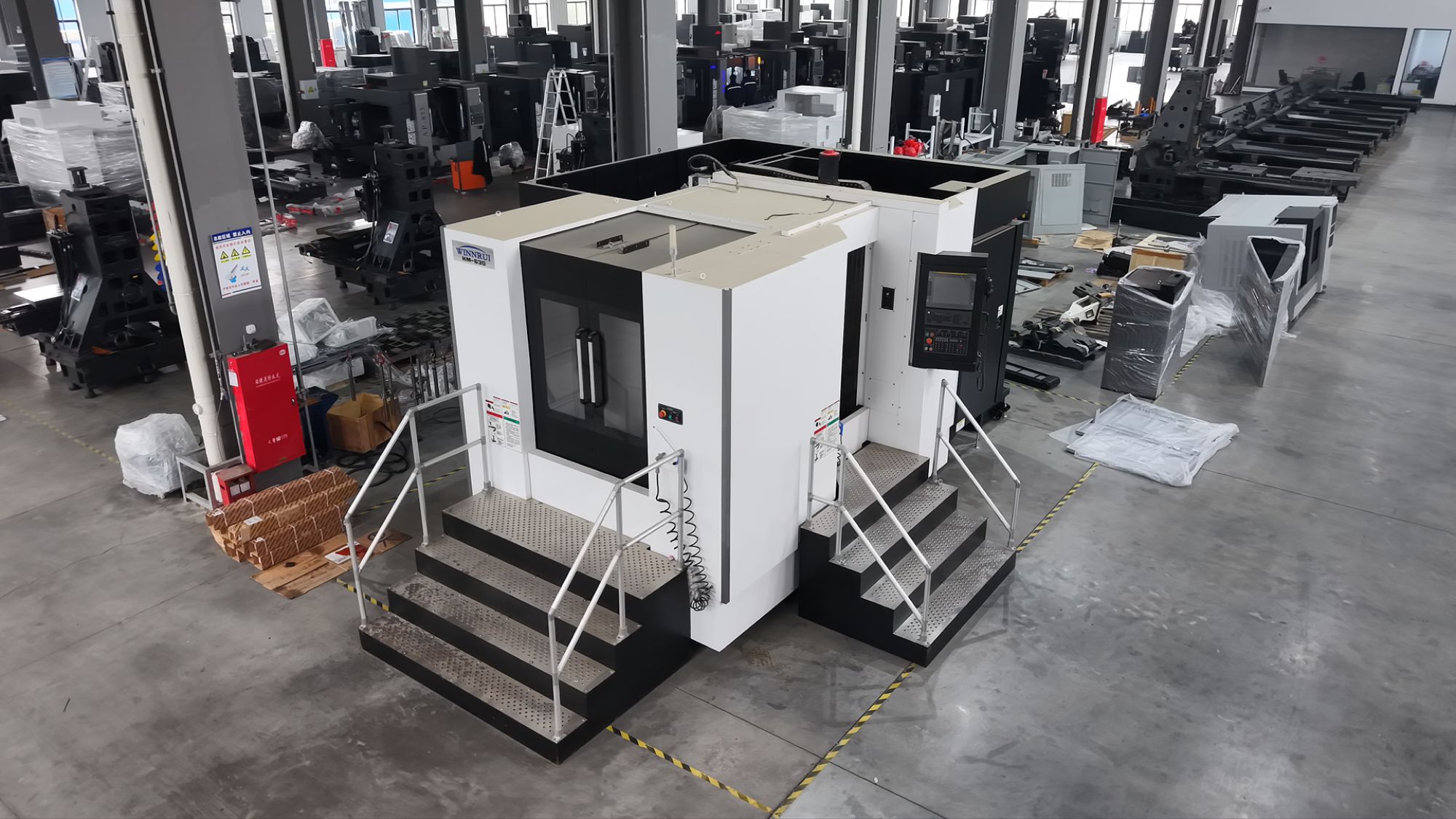
When a shop shifts from standard horizontal machining centers to a custom-built solution, the difference in achievable tolerances often comes down to intentional rigidity. Standard machines are designed to handle a broad range of work, which means compromises in mass, damping, and structural loops. A custom HMC, by contrast, can be engineered around the specific part envelope and cutting forces involved. The spindle housing might be extended or reinforced, the column might adopt a different ribbing pattern, and the workholding can be integrated directly into the machine structure rather than bolted onto a generic table. This eliminates micro-movements and harmonic vibrations that slowly eat away at precision over the course of a production run. It’s not just about hitting a tight number once—it’s about holding it from the first part to the thousandth without drift.
Beyond just the iron, custom HMCs shrink tolerance bands by embedding intelligence directly into the machining process. Instead of relying on periodic checks, these machines often include in-cycle probing that verifies critical features and feeds corrections back to the control in real time. Tool wear offsets, thermal growth of the part, even subtle coolant temperature swings can be compensated for automatically. Some setups go further by directing coolant through the spindle and fixture in a closed loop that maintains a constant thermal state, effectively neutralizing one of the biggest enemies of repeatability. The result is a process where the machine adapts to its own behavior, leaving less room for tolerance stack-up and human intervention. That kind of closed-loop consistency is what separates a general-purpose machine from one that truly elevates precision.
Streamlining Workflows with Integrated Automation
Most teams juggle a mess of disconnected tools, wasting hours on manual data entry and repetitive handoffs. When you tie your apps together under one roof, those friction points start to vanish. Real integration means more than just linking software—it’s about rebuilding the flow so tasks move without constant human nudging, freeing people to focus on work that actually requires a brain.
A smart automation layer can watch for triggers and kick off sequences across departments without anyone hitting “go.” Think of it as an invisible assistant that captures leads from a landing page, drops them into a CRM, notifies the right rep, and schedules follow-ups—all while you handle the nuance. The goal isn’t to replace judgment, just to stop burying it under busywork.
The payoff shows up quickly: shorter cycle times, fewer errors, and a team that doesn’t dread the Monday morning backlog. By merging systems and scripting the routine, you turn operational chaos into a quiet engine that runs in the background, giving everyone a bit more space to think clearly and act decisively.
Material Versatility: From Aluminum to Exotic Alloys
Aluminum often takes the spotlight for its lightweight nature and corrosion resistance, making it a go-to in automotive and consumer electronics. Yet it’s just the starting point in a vast spectrum of metals engineers rely on. From structural frames to heat sinks, its versatility lies not only in formability but also in how readily it pairs with surface treatments and coatings, adapting to everything from sleek laptop casings to rugged outdoor enclosures.
Step beyond the familiar and you’ll find stainless steels and titanium alloys quietly dominating fields that demand more muscle. Stainless adds a layer of chemical resilience that pure aluminum can’t match, thriving in medical tools and food processing equipment. Titanium, with its remarkable strength-to-weight ratio and biocompatibility, slides into aerospace brackets and surgical implants where failure isn’t an option. These aren’t just upgrades—they’re entirely different approaches to solving engineering problems.
Then there are the exotic alloys—Inconel, Hastelloy, Monel—names that sound like they belong in a sci-fi novel but actually anchor the most extreme environments on earth. Formulated to laugh at intense heat, caustic chemicals, or deep-sea pressure, they show up in jet turbine blades, nuclear reactors, and oil-well drilling gear. Their composition often blends nickel, cobalt, and chromium in precise ratios, delivering properties that leave conventional metals far behind. This tier of material versatility isn’t about choosing a better metal—it’s about rewriting the rules of what a metal can endure.
Real-World Applications: Where Custom HMCs Excel
When machining complex aerospace brackets from solid titanium billets, a standard horizontal mill often struggles with the sheer number of setups. A custom HMC, purpose-built with a B-axis rotary table and integrated probing, flips the script — it machines five faces in one clamping, slashing cycle time by over 40%. Shops running these tailored machines report fewer scrapped parts and the confidence to run overnight shifts unattended, something conventional machinery rarely delivers.
Medical device manufacturers face a different beast: tiny, intricate components like spinal implants that demand micron-level precision. Off-the-shelf HMCs simply can't hold those tolerances across high volumes. By engineering a spindle with hydrostatic bearings and custom high-pressure coolant delivery directed at the cut zone, a custom solution eliminates thermal drift and burr formation. The result is a seamless production line where each part meets spec without constant babysitting.
Maximizing ROI Through Intelligent Design
Investing in intelligent design isn't about chasing aesthetics alone—it's a calculated move to stretch every dollar. When user flows are intuitive and interfaces remove friction, conversion paths naturally shorten. Thoughtful design decisions reduce the need for costly reworks and customer support overhead, translating directly into healthier margins. The real magic happens when design systems anticipate user needs, turning casual browsers into loyal customers without aggressive marketing spend.
Data-driven prototyping and iterative testing ensure that each element serves a purpose. By analyzing behavioral patterns before full-scale development, companies sidestep expensive assumptions. This approach not only accelerates time-to-market but also builds products people genuinely want to use, creating a compounding effect on customer lifetime value. Lower acquisition costs and higher retention rates become the norm when design validates itself against real-world usage.
The overlooked aspect of intelligent design is its capacity to strengthen brand equity quietly. Consistent, accessible experiences build trust over time, reducing the need for discounting and price wars. When customers intuitively understand a product's value, sales cycles shrink, and upsell opportunities expand organically. Ultimately, design intelligence isn't a cost center—it's the quiet engine behind sustainable revenue growth that compounds with every interaction.
FAQ
Custom horizontal machining centers offer enhanced stability and chip evacuation, which are critical for maintaining tight tolerances during heavy cuts. They can be tailored with specific spindle speeds, tool capacities, and pallet systems to match unique production workflows, reducing setup times and human error.
The key difference lies in the spindle orientation and workholding approach. Horizontal centers allow the workpiece to be approached from multiple sides in a single setup, which reduces part handling and improves accuracy. Custom solutions take this further by integrating features like specialized fixturing or automation that directly address your part geometry and volume requirements.
It typically begins with a detailed analysis of your current manufacturing challenges, part specifications, and throughput goals. Engineers then propose a machine configuration with the right size, spindle, tool magazine, and control options. Prototyping and simulation are often used to validate the design before building the machine, ensuring it seamlessly fits into your existing processes.
Industries that produce complex, high-precision components in sectors like aerospace, automotive, medical devices, and heavy equipment see significant gains. The ability to handle large, awkwardly shaped parts while maintaining surface finish and tolerances makes them indispensable for hydraulic manifolds, engine blocks, and structural components.
Think about the range of part sizes, material types, and required tolerances. Also evaluate your current bottlenecks, such as long changeover times or limited tooling capacity. The machine’s footprint, coolant management, and integration with your CAM software are equally important. A good custom solution addresses these holistically rather than just adding features.
By enabling multi-face machining in one clamping, they eliminate the cumulative errors of repositioning. Custom automation, like robotic part loaders or in-process gauging, further streamlines the workflow. The robust construction and tailored spindle designs also dampen vibration, leading to finer surface finishes and longer tool life.
Conclusion
Custom horizontal machining centers are reshaping precision manufacturing by directly addressing the diverse demands of modern production. Rather than forcing operations into standardized equipment, tailored solutions adapt spindle configurations, tool changers, and workholding to specific part geometries and process sequences. This alignment drastically cuts idle time and manual interventions, especially when integrated automation streamlines part loading, in-process measurement, and chip evacuation. The immediate benefit is tighter tolerances—often down to microns—achieved through thermal compensation algorithms, vibration dampening structures, and rigid machine architectures designed for the target material, whether it is lightweight aluminum or challenging nickel-based alloys.
Beyond the technical specs, these systems prove their worth in real-world settings where complex components—such as aerospace structural frames, medical implants, or hydraulic manifolds—require both precision and repeatability. By examining a shop’s entire workflow, intelligent design choices reduce non-cut time and extend tool life, directly impacting the bottom line. This holistic approach not only meets current production targets but builds in scalability for future product lines, ensuring that every dollar invested continues to pay dividends as demands evolve.
Contact Us
Contact Person: Tim
Email: [email protected]
Tel/WhatsApp: +86 15522553731
Website: https://www.winnrui-cnc.com/