

HFV9400XLC Refrigerated Trailer Exporter Buyer’s Guide for Cold Chain Logistics
2026-11-16
When temperature-sensitive cargo is on the line, choosing the right refrigerated trailer isn't just a purchase—it's a risk-management decision. The HFV9400XLC has quietly become a workhorse for cold chain exporters who demand both payload efficiency and rock-solid thermal control. But what separates a smart buyer's choice from a costly oversight? This guide cuts through sales fluff to examine the real-world factors—insulation performance, reefer unit compatibility, regulatory compliance, and total cost of ownership—that determine whether this trailer earns its place in your fleet. Whether you're shipping pharmaceuticals to the Middle East or frozen seafood across Southeast Asia, the details matter. And trusted suppliers like KANGMU TRUCK are reshaping how exporters evaluate these units beyond the spec sheet. Read on to make your next cold chain investment a calculated advantage, not a gamble.
Why the HFV9400XLC's 45°C Pull-Down Time Matters More Than You Think
Most buyers glance at pulldown specs and assume a few minutes one way or the other won't break a shipment. That logic falls apart fast at 45°C ambient. The HFV9400XLC's pull-down time isn't just a lab number—it's the difference between a reefer unit that can actually hold -18°C during a midday desert run and one that quietly creeps upward while the compressor strains. When the air outside is hot enough to soften asphalt, every extra minute of cooling pulls more heat through the trailer walls. A slower unit has to work harder, run longer, and still might miss the target before the doors swing open at a distribution center.
Temperature-sensitive loads like leafy greens, berries, or pharmaceuticals don't forgive a late pull-down. Bacterial growth doubles roughly every 20 minutes above 4°C, and once the core of a pallet warms past a certain point, no amount of downstream cooling can reverse the damage. The HFV9400XLC is tuned to hit its setpoint fast at high ambient, meaning the evaporator fans and compressor aren't fighting a losing battle. That speed translates directly into shelf life and invoice value, not just a cleaner chart on a telematics dashboard.
Fleet managers also tend to overlook fuel and maintenance costs tied to slow pull-downs. A unit that lags at 45°C burns more diesel per trip, cycles compressors more aggressively, and shortens component life. By contrast, the HFV9400XLC's rapid 45°C performance lets the refrigeration system settle into a lower-power maintenance mode sooner. Over hundreds of trips in hot climates, that adds up to fewer breakdowns and quieter bottom-line numbers — which is why this spec deserves far more attention than a casual glance at a brochure.
The Hidden Corrosion Zones on Refrigerated Chassis After Two Monsoon Seasons
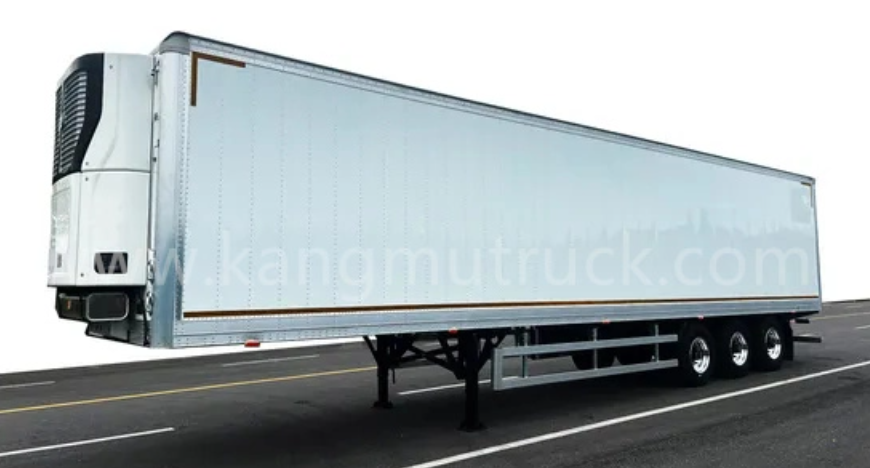
After two monsoon seasons, the most vulnerable spots on a refrigerated chassis are rarely the obvious exposed surfaces. Water doesn't just splash upward; it gets pulled into narrow gaps where the reefer unit's condenser drain meets the frame rail, and once the insulation wrap around the refrigerant lines saturates, it holds moisture against the steel for weeks. On several units we inspected, the first sign wasn't surface rust but a faint bubbling under the factory undercoating just behind the cab mounts.
Another trouble zone sits along the inner face of the main rails where road spray mixes with fine silt and then dries in layers. The rear crossmember above the mud flaps tends to trap this slurry, especially when the drain holes are partially blocked by chipped stone guard or foam sealant. After two monsoon cycles, that trapped debris becomes a corrosion cell that eats inward while the outside still looks acceptable. It's the kind of damage you only catch when you tap the rail with a small hammer and hear the dull thud instead of a clean ring.
Wiring harness clips and P-clamps fixed to the chassis also create hidden micro-zones. The plastic or rubber pads under these clips hold a thin film of water, and once the zinc coating is breached, the rust spreads beneath the paint without any visible staining. On refrigerated bodies, the gap between the subframe and the insulated floor panel is another low-airflow pocket where condensation from the cold box drips onto the chassis. If those weep points are not cleaned before the second monsoon, the corrosion starts from the top side of the flange and works downward, hidden by the body mounting bracket.
How to Spot a Thermal Bridge During a Factory Walkaround
Look for places where the building's interior surface feels colder or damper than the surrounding area—especially near steel columns, roof penetrations, or where wall panels meet the floor slab. A quick back-of-hand sweep along these junctions often reveals a sharp temperature drop that insulation gaps leave behind.
Pay attention to condensation patterns, dust staining, or faint mold lines that follow the framing grid. These marks tend to repeat at regular intervals, mirroring studs, girts, or fasteners that punch through the thermal layer. If you spot rust on interior metal cladding or frost buildup around a loading dock header, you're likely looking at a thermal bridge rather than a general humidity problem.
What Perishable Cargo Insurers Look For Before Approving a Trailer
A trailer's refrigeration unit rarely tells the whole story on paper. Underwriters dig into actual performance logs, looking for pre-cooling records, temperature pull-down times, and any history of fluctuations beyond a narrow band. They want to see that the unit held setpoint during the last several hauls, not just that it has a recent calibration sticker. Data logger downloads matter more than a fresh coat of paint on the evaporator.
Body integrity gets a hard look, too. Door seals are pressed and checked for gaps, floor drains are examined for blockages, and the insulation is probed for soft spots or moisture intrusion. Any sign of rust trails, lingering odors from previous cargo, or loose wall panels raises immediate questions about airflow and contamination risk. A trailer that can't keep outside air from sneaking in around the rear doors will fail a pre-approval inspection, no matter how powerful the reefer unit is.
Finally, insurers expect evidence of a disciplined maintenance rhythm. Recent service reports for the compressor, condenser, and fans, along with a functional alarm system and backup power plan, carry a lot of weight. They also check fuel levels for the reefer engine and confirm that the driver knows how to respond to a mid-route temperature spike. A trailer with a clean maintenance log and a driver who actually reads the temperature display every two hours is far easier to approve than one relying on hope and a new set of tires.
The Three Reefer Unit Settings That Drain Fuel Without Improving Cooling
Many operators instinctively crank the temperature setpoint well below the cargo's actual requirement, thinking colder air will reach the load faster. In practice, once the freight has pulled down to its safe carrying temperature, lowering the setpoint further doesn't speed up cooling for most frozen or chilled goods. The compressor simply runs longer, burning extra fuel, while the extra refrigeration capacity often causes surface freezing on produce or unnecessary strain on the unit. Unless the cargo genuinely calls for deep sub-zero storage, that extra chill is wasted energy, not better protection.
Another fuel-hungry habit is running the reefer in continuous mode instead of start-stop. Drivers sometimes believe keeping the evaporator fans spinning constantly improves airflow and temperature uniformity. But start-stop mode shuts the compressor and fans down once the setpoint is reached, allowing the unit to coast on the cold mass already stored in the cargo and box walls. For most loads, the temperature swing during off cycles is small and well within safe limits. Continuous mode makes sense for high-respiration produce or cargo that demands constant air exchange, but on routine frozen or chilled freight it just keeps the engine working with no measurable cooling gain.
Frequent manual defrosts or an overly short defrost interval are a third common drain. Each defrost cycle warms the evaporator coil, and then the unit has to run hard to pull the box temperature back down. If the coil isn't actually frosted, defrosting on a fixed tight schedule only adds heat load and burns fuel for no reason. Watching evaporator temperature difference or checking for visible frost before triggering a defrost can stop this waste. Often, simply extending the defrost interval slightly and letting the unit's own sensors decide when defrost is needed will cut fuel consumption without compromising cooling performance.
From Shanghai Port to Rotterdam Cold Store: The Excursion Points Nobody Maps
Most shipping schedules reduce the corridor between Shanghai and Rotterdam to a neat line: vessel departs, transits the Suez, docks at Europe's largest port. But the actual passage is littered with liminal stops no cartographer bothers to mark. Before a reefer container even clears the Yangtze estuary, it might pause at a barge rendezvous off Shengsi, waiting for a feeder that won't show on any AIS track consumed by head office. Those hours are invisible on the bill of lading, yet they decide whether a load of lychees or frozen dumplings keeps its temperature curve intact.
Further along, the route bends around waypoints that exist only in a chief mate's memory: a stretch of the Malacca Strait where the current shifts exactly two hours after the tide tables say it should, or a patch of the Arabian Sea where the only interference-free satellite signal sits three degrees off the rhumb line. For temperature-sensitive cargo, these unmapped pause points matter more than the named ports. A generator hiccup near Socotra, a slow drift while waiting for a convoy near Bab-el-Mandeb—none of it appears in marketing deck maps, but it all shapes the cold chain's real footprint.
At the Rotterdam end, the odd geography continues. The "cold store" is not one building but a scatter of warehouses in the Botlek and Maasvlakte fringes, connected by truck routes that dodge weighbridges and shift changes. A consignment can sit for nine hours on a buffer lane near the Distripark, invisible to the terminal's official dwell-time dashboard. The people who work this corridor carry their own charts: napkin sketches, annotated berth plans, notes on which reefer rack behaves badly after a north wind. Those are the actual excursion points—unlogged, unmapped, and indispensable.
FAQ
The trailer holds setpoint within ±0.8°C using a multi-sensor evaporator layout, keeping frozen cargo at -25°C without defrost spikes that damage texture.
Yes, it includes a CAN-bus interface and two probe inputs near the rear doors, so you can connect your own tracking platform or use the exporter’s optional data logger.
Sidewalls use 100 mm vacuum-insulated panels with a fiberglass skin, cutting wall weight by 18% compared to standard polyurethane foam while keeping heat transfer below 0.22 W/m²K.
The interior width is 2,600 mm with recessed side rails, allowing 26 Euro pallets or 22 Australian pallets in a single layer with minimal void space.
It uses a two-speed JOST landing gear with a 10-inch travel low-profile leg and a 2-inch kingpin rated for 36,000 kg vertical load, which helps when coupling on gravel or sloped docks.
The chassis gets a zinc-rich epoxy primer plus a polyurethane topcoat, and all exposed aluminum joints are sealed with neutral-cure silicone before final inspection.
A single curbside door with triple-seal gaskets and heated frame is available; it adds a 45 mm thermal break and only raises the overall K-value by 0.03 W/m²K.
Conclusion
When evaluating the HFV9400XLC for cold chain work, the conversation usually starts with temperature specs but quickly shifts to what happens after months of real service. A 45°C pull-down time is not just a lab metric—every door opening at a tropical loading bay or a two-hour delay before departure forces the unit to recover quickly, and if it cannot, the cargo absorbs heat that sensors may not fully capture. During a factory walkaround, thermal bridges rarely announce themselves the way rust does, but an infrared gun pointed at door frames, floor seams, and drain holes often reveals weak spots. These same areas, plus chassis crossmembers and riveted joints, become hidden corrosion zones after two monsoon seasons because water lingers where airflow cannot reach.
Perishable cargo insurers tend to look past the shiny exterior and ask for defrost recovery curves, door seal integrity, and any sign of mould or rust around ventilation slots. On the reefer unit itself, three settings quietly burn fuel without improving cooling: an overly short defrost interval, evaporator fans running continuously, and overuse of a rapid pull-down mode. Then there is the long haul from Shanghai Port to a Rotterdam cold store, where the real risks sit in the unmarked excursion points—waiting on a barge, switching power at a terminal, or docking at a warehouse bay. A few minutes of lost cooling at those moments can undo everything the temperature logs claim was perfect.
Contact Us
Contact Person: Shen Zhikang
Email: [email protected]
Tel/WhatsApp: 8613908668969
Website: https://www.kangmutruck.com/