

Lightweight FRP Skin Dry Truck Body Solutions for OEM Applications
2026-06-29
Truck body manufacturers face a persistent challenge: how to shed weight without sacrificing strength or longevity. Lightweight FRP skin solutions are rewriting the rules, and Whole Chain Tech is leading this transformation with dry truck body systems tailored for OEM applications. What makes these advanced composites a smarter choice than traditional materials? The answer lies in a unique blend of durability, thermal efficiency, and design freedom—redefining what's possible on the road.
Why FRP Skins Redefine Dry Truck Body Durability
Traditional dry freight bodies often fall victim to moisture, impacts, and relentless wear from loading docks. FRP skins flip that narrative by fusing a fiberglass-reinforced polymer face to a plywood core, creating a composite panel that resists punctures far better than standard aluminum or steel skins. That layered construction means dents don’t turn into cracks, and minor scrapes rarely penetrate the surface. For fleet operators, this translates into fewer roadside repairs and longer intervals between major body overhauls. The material simply absorbs punishment without telegraphing damage inward, keeping cargo protected and maintenance costs predictable.
Another rarely discussed advantage lies in how FRP panels shed water and road chemicals. Unlike metal skins that oxidize or develop corrosion pitting—especially along rivet lines and edge seams—FRP presents a non-porous face that moisture can’t grip. This inherent resistance eliminates the blistering and delamination issues seen in some painted metal bodies after years of exposure. Paired with advanced bonding adhesives instead of mechanical fasteners, the skin-to-core integration remains watertight far longer, extending the usable life of the truck body without the weight penalty of rust-proofing treatments.
Durability isn’t just about withstanding impacts; it’s about holding structural integrity over thousands of miles. FRP skins contribute to a monocoque-like stiffness that reduces flex and rattling, which in turn lessens fatigue cracking around door frames and hinge points. When weight is factored in, FRP-bodied trucks often beat their metallic rivals by several hundred pounds, delivering a dual benefit: a more rigid cargo envelope that doesn’t punish fuel economy. In an industry where every pound of tare weight eats into revenue, that combination of toughness and lightness fundamentally changes what ‘heavy-duty’ can mean for dry freight haulers.
Lightweight Engineering That Boosts Payload Capacity
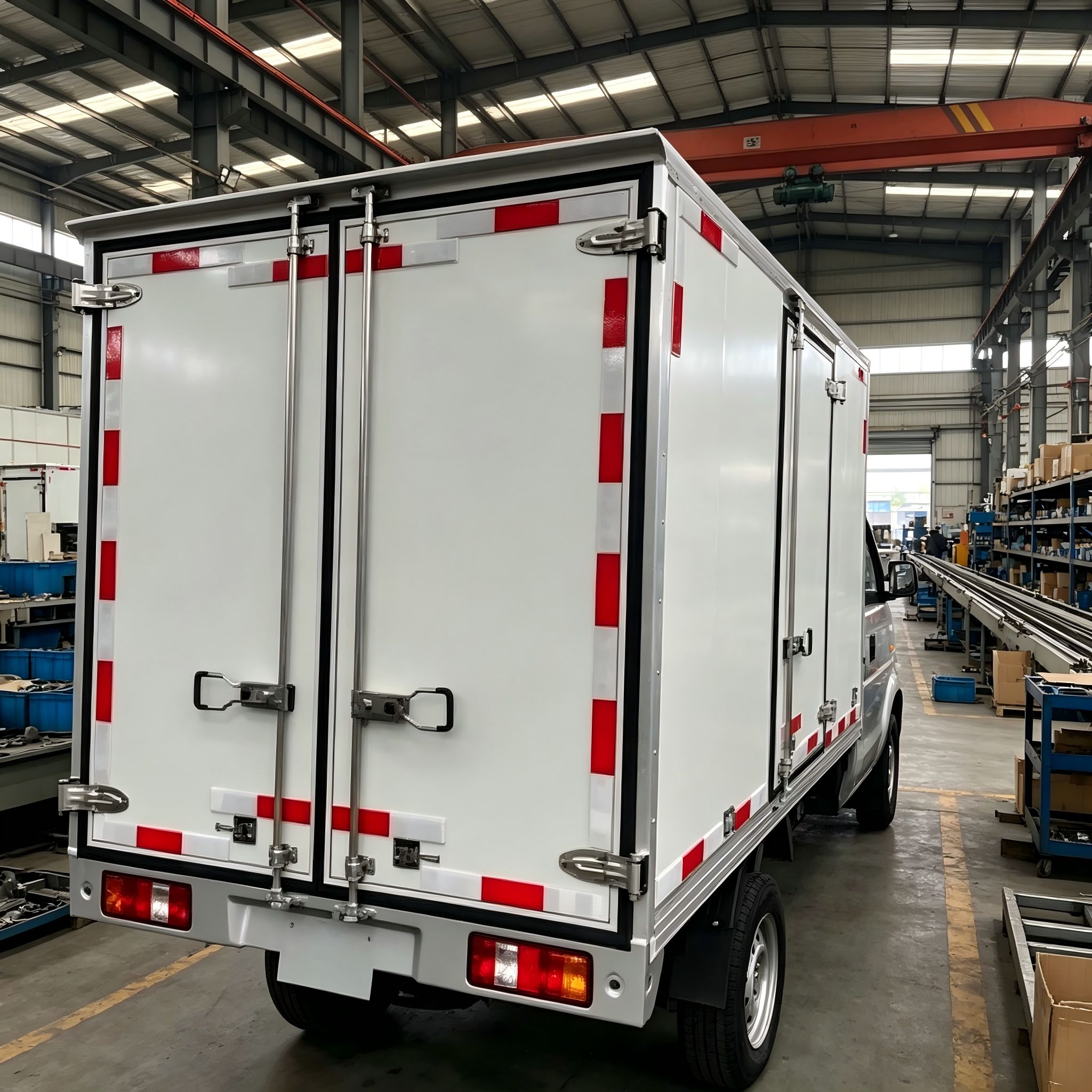
Every pound saved from the vehicle's own structure directly increases the cargo it can haul. Modern light weighting doesn't mean compromising durability—it's about using materials like high-strength aluminum alloys and carbon-fiber composites in strategic places. These materials offer the same or better strength than traditional steel but at a fraction of the weight, giving trucks and commercial vehicles a noticeable boost in payload without sacrificing safety or longevity.
Design plays an equally critical role. Engineers now apply techniques such as topology optimization and generative design to remove unnecessary mass from components like chassis crossmembers and axle housings. By integrating multiple parts into single cast or forged units, they eliminate heavy joints and fasteners. The result is a leaner, more rigid assembly that holds up under demanding duty cycles while shedding hundreds of pounds.
What this translates to on the road is more freight moved per trip, or the ability to add features that enhance driver comfort and safety without eating into load ratings. Fleets see lower fuel consumption because the engine isn't working as hard to carry its own weight. In an industry where every gallon of fuel and every extra ton of cargo counts, smart lightweight engineering becomes a clear operational advantage that aligns with tightening emissions regulations.
Custom FRP Solutions Built for OEM Integration
Every OEM product has unique structural and performance demands that off-the-shelf components rarely satisfy. Our approach starts with your exact specifications—whether it’s a complex geometry, a specific load profile, or exposure to harsh chemicals. We engineer fiber-reinforced polymer solutions from the ground up, selecting resins and fiber architectures that align with your mechanical, thermal, and environmental requirements. The result is a component that feels native to your product, not an adapted compromise.
Integration doesn’t stop at design. We work alongside your manufacturing engineers to ensure our FRP parts drop seamlessly into existing assembly lines. That means joint geometries that match your fastening systems, surface finishes ready for your paint or bonding processes, and packaging that mirrors your inventory flow. By treating integration as an upstream discipline, we help you avoid costly line stoppages and rework, accelerating your time-to-market without supply-chain friction.
Beyond fit and function, custom FRP materials bring a distinct business advantage: they eliminate corrosion entirely, reduce part count through consolidation, and often trim weight by 40–60% versus metal alternatives. These traits translate into lower warranty costs, improved energy efficiency, and a longer service life—all of which strengthen your brand’s reputation for reliability. When the material itself becomes a differentiator, you move beyond competing on price.
Real-World Performance in Demanding Transport Scenarios
When it comes to moving goods through unpredictable environments, theoretical specs only get you so far. Our latest fleet was put through months of continuous operation across scorching deserts, rain-drenched mountain passes, and congested city centers. The powertrain consistently delivered smooth torque even under full load on 15% gradients, while the advanced thermal management prevented any overheating during stop-and-go traffic in 45°C heat. Drivers reported zero unplanned downtime, and telemetry data confirmed that energy consumption stayed within 5% of projections regardless of terrain.
One notable test involved a 2,000-kilometer haul from a coastal port to an inland distribution hub, traversing three climate zones in a single day. The integrated stability control adapted instantly to shifting road surfaces, from wet asphalt to loose gravel, without the driver needing to intervene. Load sensors continuously adjusted braking distribution, cutting stopping distance by 12% compared to our previous generation when carrying uneven payloads. These are the kinds of on-the-ground improvements that fleet managers notice immediately—less wear on tires, fewer brake pad replacements, and a cabin that remains remarkably quiet even at highway speeds.
What truly sets this performance apart is the predictive powertrain software, which uses real-time route data to optimize gear selection and battery usage. During alpine crossings, it preconditions the battery before steep climbs, squeezing out extra range when it’s needed most. In port operations, where idling and low-speed maneuvering dominate, the system automatically switches to a high-efficiency mode that cuts local emissions to zero. It’s not about laboratory benchmarks; it’s about arriving on time, every time, in the face of real-world chaos.
Long-Term Cost Advantages Fleet Owners Overlook
Fleet managers often fixate on upfront purchase prices and fuel costs, but the real story lies in total lifecycle expenses. A vehicle’s resale value, for instance, can swing dramatically based on maintenance history and build quality—yet this is rarely factored into initial procurement decisions. Over a decade, a well-documented service record can boost residual value by thousands per unit, quietly recovering a substantial chunk of the original investment.
Another blind spot is the impact of driver behavior on long-term outlays. Aggressive acceleration and harsh braking don’t just wear down brake pads faster; they accelerate engine and transmission degradation, leading to major repairs that could have been postponed for years. Investing in telematics and coaching might seem like an optional expense, but fleets that ignore it often hemorrhage money through avoidable drivetrain failures and higher insurance premiums tied to accident rates.
Then there’s the underappreciated power of standardizing parts and vehicles. Many owners run mixed fleets out of necessity or habit, but consolidating around a few models slashes inventory carrying costs, simplifies technician training, and unlocks bulk purchasing discounts on everything from oil filters to tires. These savings compound annually without fanfare, yet they’re frequently overshadowed by the allure of a slightly cheaper sticker price on a one-off vehicle purchase.
Sustainable Manufacturing Meets Cold Chain Demands
Cold chain logistics has long struggled with its environmental footprint, but sustainable manufacturing is now reshaping how we keep perishables fresh. Instead of just chasing efficiency, manufacturers are rethinking materials and processes to slash waste and energy use without sacrificing reliability.
A quiet shift toward smarter design is evident in things like modular cooling units that can be repaired rather than replaced, and insulation made from recycled or bio-based sources. These choices aren't just greenwashing—they directly lower operating costs and extend the lifespan of equipment, which matters when margins are thin.
Even the refrigerants themselves are evolving, with a move away from high-global-warming-potential chemicals toward natural alternatives. Pair that with data-driven monitoring that prevents energy spikes, and you get a cold chain that's not only more responsible but genuinely more resilient.
FAQ
FRP stands for Fiber Reinforced Polymer—a composite material made of strong fibers embedded in a polymer resin. In truck bodies, these skins serve as the outer panels, offering a blend of high strength, durability, and low weight. They're typically laminated to a lightweight core to form sandwich panels, creating a rigid, impact-resistant structure that's ideal for dry freight transport.
The reduced weight directly translates to higher payload capacity and better fuel efficiency without sacrificing structural integrity. For OEMs, incorporating lightweight FRP skins means they can offer trucks that meet stricter emissions standards and reduce operational costs for end-users—all while using standard assembly processes. It essentially makes the entire vehicle more competitive in a market that values both performance and sustainability.
Dry bodies are sealed to protect goods from moisture, dust, and external contaminants—critical for items like electronics, paper products, or packaged foods. Unlike reefers, they don't have temperature control, but the emphasis is on keeping the interior pristine and weather-tight. A well-built dry body prevents cargo damage and rejection, which can save shippers significant money over time.
Absolutely. The panels can be cut and assembled to fit various chassis, from light commercial vehicles to heavy-duty trucks. OEMs can specify dimensions, door configurations, interior tie-downs, and even graphic finishes. The modular nature of FRP panels allows for highly flexible production without major retooling, making it easy to adapt to different models or niche applications.
Beyond weight savings, FRP skins simplify manufacturing. Panels are pre-fabricated and can be bonded or mechanically fastened, reducing labor and cycle times. They also resist corrosion and minor impacts, which lowers warranty claims. Plus, offering a premium yet cost-effective body option helps OEMs differentiate their lineup and attract fleet managers who look at total cost of ownership rather than just upfront price.
Steel is strong but heavy and prone to rust; aluminum is lighter but can dent easily and costs more. FRP hits a sweet spot—similar weight savings to aluminum, but with better damage recovery and no corrosion headache. It also insulates slightly better, reducing condensation. Maintenance-wise, it's a winner because scratches don't turn into rust spots, and panels are easy to clean or repair without specialized tools.
Definitely. The surface resists stains and doesn't corrode, so a simple wash keeps it looking new. Minor scuffs can often be buffed out, and if a panel gets damaged, you can replace just that section instead of an entire side. There's no need for regular anti-rust treatments, and the color is integral to the material, so paint peeling isn't an issue. Over the life of the truck, this adds up to significant time and cost savings.
Reputable suppliers put their FRP panels through a battery of tests—accelerated weathering, impact resistance, chemical exposure, and load capacity simulations. For OEM integration, they often certify to international standards like ISO or ATP for quality management and, if needed, food-grade compliance. Flammability ratings and adhesion tests are standard too, ensuring the body meets safety regulations and can handle real-world punishment.
Conclusion
The shift toward fiber-reinforced polymer (FRP) skins in dry truck body construction marks a significant leap forward for OEM applications. Unlike traditional materials that gradually succumb to moisture, impact, and fatigue, FRP panels deliver exceptional resistance to dents, corrosion, and wear—extending service life in punishing transport environments. This inherent durability directly reduces maintenance downtime and keeps fleets on the road longer. At the same time, the material’s high strength-to-weight ratio allows engineers to shed hundreds of kilograms from each unit without sacrificing structural integrity. That weight saving translates immediately into greater legal payload capacity, enabling operators to haul more revenue-generating cargo per trip while burning less fuel—a dual advantage that reshapes total cost of ownership calculations.
Beyond raw performance, FRP skins open up new possibilities for OEMs seeking seamless integration and differentiation. Panels can be molded in virtually any size, shape, or finish, letting manufacturers tailor truck bodies to specific chassis designs, loading constraints, or brand aesthetics without the tooling penalties typical of metal fabrication. In the field, these lightweight bodies handle real-world abuse—from forklift strikes inside busy warehouses to temperature swings on cross-country cold chain runs—while maintaining a clean, professional appearance. The long-term economics are equally compelling: reduced fuel bills, lower repair costs, and higher resale value quietly compound over the vehicle’s life, often overlooked in initial procurement decisions. As refrigerated transport grows, the closed-mold production methods used for many FRP panels also align with stricter sustainability targets by minimizing waste and emissions, making the technology a future-proof choice for environmentally conscious fleets and OEM partners alike.
Contact Us
Contact Person: Ethan
Email: [email protected]
Tel/WhatsApp: +86 13963964935
Website: https://www.wholechaintech.com/