

OEM Charging Hose: Key Factors to Consider Before Buying
2026-11-18
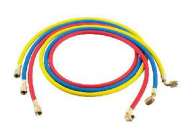
When your equipment runs on refrigerant, the charging hose you choose can either keep service calls simple or turn them into recurring headaches. OEM charging hoses may look interchangeable on a shelf, but small differences in hose wall thickness, gasket material, and end fitting tolerances show up quickly under daily vacuum and pressure cycles. Before you buy another batch, it pays to know which construction details actually protect your manifold set and your customer’s system—and why many technicians now look for HONGSEN when they want a hose that survives the truck, not just the parts counter.
Material Choice When Charging Cycles Run Hot and Long
High-temperature cycling pushes ordinary cathode materials into accelerated decay paths. Nickel-rich formulations may offer energy density, but their surface reactivity climbs sharply once the cell spends hours above 45°C. A more restrained nickel content, paired with a stabilizing dopant or coating, often keeps oxygen loss and microcracking in check when every cycle adds thermal load.
The anode side matters just as much. Graphite works until repeated expansion and contraction begin exposing fresh surfaces that eat into the electrolyte. Blends with hard carbon or surface-treated graphite can slow this, but the real lever is usually the electrolyte. Additives that build a durable, heat-tolerant interphase do more for long hot runs than chasing a slightly higher initial capacity.
Separators and binders rarely get the attention they deserve until a cell turns into a swollen failure. In prolonged heat, standard polyolefin separators can lose dimensional stability, while fluorinated binders may soften unevenly. Choosing materials that hold their mechanical and chemical behavior above 60°C—not just at room temperature—becomes the difference between a battery that fades gracefully and one that fails without warning.
Pressure Ratings That Cover Real Surge Conditions
Engineers often discover that nominal pressure ratings tell only part of the story once a system meets abrupt valve closure or pump trip. The rating on a data sheet may look sufficient, yet transient spikes can push components well past their steady-state limits in milliseconds. Covering real surge conditions means selecting equipment whose fatigue margin and short-duration overpressure tolerance match the actual waveform, not just the line's design pressure.
A useful approach is to compare the surge analysis output against the manufacturer's allowable pressure-temperature envelope for transient events. Some components handle brief excursions above the published class rating if the duration and frequency stay within defined bounds, while others may deform seals or crack castings after only a few cycles. Field records from similar plants are just as important as lab curves here, because installation details often determine whether a predicted surge stays within a safe band.
It also helps to treat surge protection as a system property rather than a single valve rating. Air valves, check valves, and pump control logic all shape the pressure spike before it reaches weaker fittings. When the specification clearly states the expected surge amplitude, rise time, and repeat count, suppliers can offer ratings that reflect operating reality instead of only test-bench conditions.
Fitting Connections That Avoid Adapter-Related Leaks
Most leaks that get blamed on fittings actually start at the adapter, not the hose or tube end. Every extra connection adds two sealing surfaces and a new opportunity for slight misalignment, over-tightening, or thread galling. Choosing a fitting profile that threads directly into the component removes that middle adapter entirely, so the sealing load lands on one controlled surface instead of being spread across a stack of bushings and reducers.
The tooth profile and seat geometry matter more than the wrench size. A 24-degree cone, an O-ring face seal, or a machined flare that matches the receiving port will hold far better than a generic pipe thread wrapped in tape. When the nose of the fitting and the seat are cut to the same angle, tightening produces a narrow, high-pressure contact band rather than a wedge that loosens under vibration or temperature swings.
Material pairing should also be considered before the first turn of a wrench. A stainless fitting in an aluminum housing can creep or loosen when the system heats up, while a soft copper washer may extrude if it sits against a rough face. In many systems, replacing a multi-piece adapter stack with a single, purpose-made connection reduces the parts count, eliminates hidden leak paths, and makes service faster without needing a special sealant.
Bend Radius and Routing Through Crowded Equipment Bays
Running cable through a densely packed equipment bay forces you to think about bend radius long before the first connector gets terminated. Each manufacturer publishes a minimum bend radius, but the real problem shows up when the cable path snakes past power supplies, cooling fans, and sharp chassis edges. A bend that looks acceptable on paper can exceed the rated limit once the cable is cinched down or forced around an existing bundle. Fiber is especially unforgiving; a tight kink may not break the glass immediately, but it can create micro-cracks that lead to intermittent loss or premature failure under thermal cycling.
Practical routing starts with mapping the longest and least obstructed path, not the shortest straight line. Leave extra slack in a service loop near the point of termination, but keep that loop wide enough to respect the manufacturer's stated radius. When multiple cables share a tray or rack rail, stagger the bends so no single point becomes a pinch zone. Use radius-limiting edge protectors at frame cutouts and avoid zip-tying directly over a bend, since the tension turns a gentle arc into a hard crease. In crowded bays, a common mistake is pulling a jumper tight against a neighboring card cage; that pressure points translate into localized stress that no amount of cable management magic can fully undo.
If the bay is already at capacity, consider splitting the run into smaller segments with an intermediate patch panel or routing through an adjacent, less congested vertical channel. Document the exact bend points during installation and compare them against a simple go/no-go gauge sized for the cable type. A few minutes spent verifying curvature beats chasing a ghost fault later, because cable that looks fine on the outside can hide a crushed buffer tube or a cracked fiber core inside.
Certification and Inspection Records Worth Verifying Early
Waiting until the shipment is already on the water turns certification checks into a scramble. A certificate that looks valid on first glance often expires mid-order, or the scope of approval covers a factory location that no longer handles your product. Pulling those records early gives you room to request renewals, clarify gaps, or switch suppliers without holding up production.
Inspection reports deserve the same timing. A clean report from a previous batch does not tell you much about the current run, especially if materials, line speed, or key personnel changed in between. When you review test data, batch numbers, and inspector notes before final packing, small inconsistencies become negotiating points rather than post-arrival surprises.
Early review also forces the supplier to treat your order as a priority. The request itself signals that paperwork will be checked against the physical goods, not filed away. Suppliers who balk at sharing current records usually have a reason, and that reason is cheaper to address while the order is still in your control.
Replacement Timing and Downtime Costs Most Buyers Overlook
Most purchase comparisons focus heavily on unit price, but the real money often disappears when a component decides to fail at the wrong moment. A part that costs a little less may need replacement twice as often, or it may run fine until it suddenly takes down an entire line. The invoice for the part itself rarely shows the cost of halted production, rushed shipping, overtime labor, or missed delivery windows.
There is also a tendency to treat replacement timing as a maintenance issue rather than a purchasing issue. Buyers wait for visible failure, then pay a premium for emergency stock or accept whatever lead time is available. By contrast, planned replacement during scheduled downtime usually costs less and creates fewer ripple effects. A slightly shorter service life can be acceptable if it aligns with existing service intervals; a longer claimed life means little if it ends in unplanned stoppage.
A more useful approach is to make replacement timing a formal part of supplier evaluation. Ask about typical failure windows, local buffer stock, and guaranteed response times before signing. Suppliers that can commit to predictable replacement cycles often save more than a marginally lower quote, because the true cost is not the component sitting on the shelf but the equipment standing still.
FAQ
Check the hose material and inner liner compatibility. Many OEM hoses handle R134a and R1234yf, but mixing refrigerants or using an incompatible liner can cause swelling, leaks, and premature failure. Match the hose spec to the refrigerant listed in the owner's manual.
Yes, because charging hoses see both static high-side pressure and spikes during charging. A hose rated below the system's high-side pressure can burst or leak at the crimp. Look for a working pressure comfortably above the max high-side reading, not just equal to it.
Confirm the thread size, seat angle, and whether the port uses a quick-connect or flare fitting. A hose with the right length but wrong fitting can damage the service port or refuse to seal. Bring the old hose or the vehicle's service port specs if you can.
Not necessarily. Longer hoses add more internal volume, which can affect refrigerant charge accuracy and make purging more difficult. Choose a length that reaches comfortably without needing sharp bends or tight loops.
Very important. The hose must stay flexible and hold pressure near exhaust components, turbochargers, or hot intake paths. A lower-temperature hose can harden, crack, or blow out. Look for a temperature range that covers the worst under-hood heat, not just ambient weather.
You can if the specs match, but OEM hoses are built around specific routing, bend radii, and end fitting clocking. Aftermarket options may rub, kink, or place strain on the service port. Compare the hose bend shape and length before substituting.
Cracks in the outer cover, exposed braid, bulges near fittings, stiffness, or oil residue around the crimp are all warning signs. If the hose has been used with contaminated refrigerant or has flattened spots, it is safer to replace it than to risk a slow leak or sudden burst.
A larger bore moves refrigerant faster but can be harder to control for small top-offs and may trap more refrigerant when disconnecting. A smaller bore gives finer control for precise charging but slows down full system fills. Match bore size to the job: smaller for top-offs, larger for evacuation and full charges.
Conclusion
When charging cycles run hot and long, the hose material stops being a minor spec and becomes the main reason a setup either holds together or fails early. A compound that tolerates repeated heat soak, oil mist, and flexing will outlast a generic hose that only looks acceptable on a datasheet. Pressure ratings deserve the same scrutiny: steady-state numbers rarely capture the spikes from compressor starts, valve shifts, or abrupt disconnects, so the hose needs to handle real surge conditions without eating into its safety margin. At the ends, leak problems often trace back to adapter stacking and mismatched seat angles. An OEM charging hose with properly matched fitting connections removes that weak point instead of relying on extra adapters that invite slow refrigerant loss.
Routing through a crowded equipment bay makes bend radius as important as the pressure figure. If the hose is forced into a tighter curve than the manufacturer allows, the inner liner can kink, the reinforcement can fatigue, and the fitting can take side load that shortens service life. A hose with a realistic minimum bend radius is easier to place without creating a future failure point. Certification and inspection records are also worth verifying before the first install, not after a problem appears; batch test data, material traceability, and pressure-test documentation can separate a consistent OEM product from something that merely looks equivalent. Replacement timing and downtime costs are easy to underestimate as well. Hoses rarely fail without warning signs like hardening, cracking, or fitting corrosion, and scheduled replacement is usually far cheaper than an unplanned shutdown during a busy charging window.
Contact Us
Contact Person: KOPASS HO
Email: [email protected]
Tel/WhatsApp: 8613606566112
Website: https://www.hongsenref.com/