

Polycarboxylate Superplasticizer within the Industry and Why It Leads
2026-08-29
Polycarboxylate superplasticizer (PCE) has moved from lab curiosity to industry backbone faster than any admixture in recent memory. Its edge isn't accidental—it comes down to molecular control that older lignosulfonates or naphthalene-based products simply can't match. For contractors and precasters, that means lower water-cement ratios, longer workability windows, and concrete that performs under pressure. Yet not all PCE is created equal. That's where HAISEN enters the conversation, pushing the chemistry from incremental gains to measurable jobsite advantages. Here's what makes PCE the leader—and why the choice of supplier matters more than ever.
What PCE Does to Cement Particles That Older Dispersants Cannot
Conventional dispersants such as lignosulfonates or naphthalene sulfonate rely almost entirely on electrostatic repulsion. They adsorb onto cement grains and impose a negative charge that pushes particles apart. But this effect collapses in the calcium-rich, high-ionic-strength environment of fresh concrete: the charges are shielded, particles touch, and the mix stiffens. PCE molecules work differently. Their backbone anchors to the cement surface while long polyether side chains stretch into the pore solution, forming a brush-like layer. This steric hindrance keeps cement grains separated even when electrostatic forces alone would fail, which is why PCE can produce high flow at dramatically lower water content.
That structural advantage also changes how the mix behaves over time. Older dispersants often need to be overdosed or paired with retarders to keep slump, and they can intensify bleeding or delay setting unpredictably. PCE can be designed at the molecular level: side chain length, charge density, and adsorption strength can be adjusted to control when and how the polymer works. The result is a dispersant that not only deflocculates cement particles immediately but also maintains that separation long enough for placement, without the side effects that used to be accepted as normal.
The Slump Retention Puzzle and How PCE Solves It
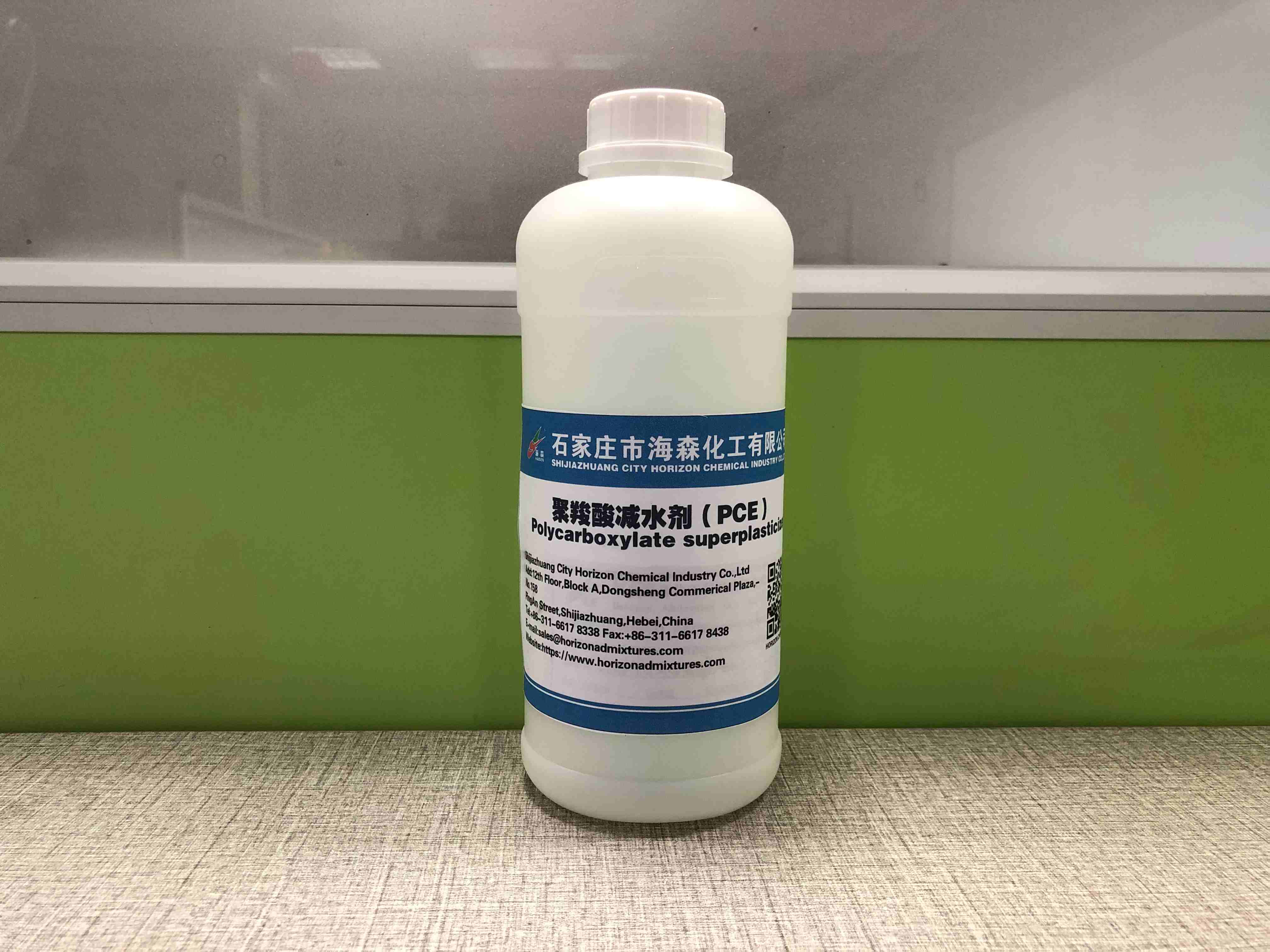
Losing slump between the batch plant and the pour site is one of those field problems that rarely shows up in lab trials. Cement hydration advances quickly in warm weather, and the first generation of high-range water reducers gets consumed or buried under hydration products, so what mixed at an 8-inch slump can arrive at the forms closer to 4. Contractors then add water on site, which quietly undercuts strength and durability even when cube tests still pass.
PCE takes a different route because its molecular shape is not fixed. Grafting long polyethylene oxide side chains onto a carboxylate backbone creates a steric barrier that keeps cement grains apart longer than electrostatic repulsion alone. By tuning the acid-to-ester ratio, side chain length, and grafting density, formulators can slow the initial adsorption or design the polymer to release active dispersant gradually as the paste alkalinity changes. That turns slump retention from a guessing game into something you can dial in for a 90-minute haul or a two-hour pumping window without overdosing retarder and stalling early strength.
Why PCE Is Less Sensitive to Cement Variations Than You Expect
PCE's tolerance to cement variability often surprises people who are used to older water reducers. The key lies in how it disperses cement particles: instead of relying mainly on electrostatic repulsion, which is easily disrupted by changes in sulfate or alkali levels, PCE works through steric hindrance from its grafted side chains. This physical barrier remains effective even when the surface charge of cement grains shifts from one batch to the next, so slump retention and workability stay more consistent than you would predict from raw material chemistry alone.
Another factor is the flexible molecular architecture of PCE. Manufacturers can adjust the backbone length, side chain density, and charge density to match a wide range of cement compositions. That means a well-designed PCE already anticipates common variations in C3A content, fineness, or gypsum form. Rather than reacting sharply to every change in the cement, the admixture absorbs those differences through its adsorption behavior and layer thickness, which keeps the water demand and setting time within a narrower window.
Field experience points the same way. Concrete producers often switch between cement sources or encounter seasonal changes in clinker reactivity, yet PCE-dosed mixes typically need far fewer dosage adjustments than naphthalene or melamine-based products. This is not because PCE ignores the cement, but because its mode of action and molecular customization give it a wider operating envelope. As a result, the practical sensitivity to cement variations ends up much lower than a simple look at the chemistry would suggest.
From Lab Mixes to High-Volume Pours: PCE in the Real World
Lab trials make PCE look almost too easy. A few hundred grams in a clean mixer, controlled temperature, deionized water—everything behaves. Then you're on a job site with a 10-yard truck, sandy aggregate that's been sitting in the rain, and a batch plant that's been running nonstop since 5 a.m. The same dosage that gave you a 9-inch slump at the lab might give you a 6-inch slump on the first truck and a 10-inch slump on the third. That gap isn't a dosing error; it's the gap between lab conditions and the messier reality of high-volume pours.
One thing that rarely shows up in lab reports is how much clay in the aggregate can eat your PCE. Even 1% clay fines can cut dispersion efficiency by 20–30%, and most spec sheets won't tell you that. On big pours, we sample the sand and coarse aggregate the day before, run a mini-slump with the actual batch water, then adjust the PCE dose or switch to a more clay-tolerant formulation. It's not unusual to bump the dosage by 15% just to offset the fines, especially if the aggregate pile got rained on.
High-volume pours also change the timing game. A lab mix might hold slump for 60 minutes, but a truck stuck in traffic for 90 minutes on a hot afternoon will lose workability faster than you can say "re-temper." You can't just add water. Instead, you stage the PCE—half at the plant, half on site—or use a slump-retaining PCE with a longer side chain. It costs a bit more per yard, but it's cheaper than tearing out a cold joint.
Comparing Cost per Meter: When PCE Beats Cheaper Alternatives
At first glance, a lower price per meter from a generic cable or conduit seems like the obvious budget win. But that comparison collapses once you account for how much material actually gets used on site. PCE’s bend radius, tensile rating, and jacket durability often allow longer uninterrupted runs with fewer pull boxes and splice points. Less hardware, fewer failure-prone connections, and quicker installation eat into the upfront price gap faster than most estimators expect.
Cheaper alternatives also tend to demand more frequent replacement in conditions that PCE handles without much thought: UV exposure, oil, abrasion, temperature swings. A cable that saves you eighty cents per meter but needs to be ripped out and reinstalled after two seasons is not a bargain. The real cost per meter includes the labor to install it, the downtime when it fails, and the price of the second or third replacement you never planned for.
So when the job involves buried runs, wet locations, tight conduit fills, or any environment where access is expensive, PCE typically wins the cost-per-meter discussion. Not because it is cheaper on the invoice, but because it converts each purchased meter into more usable, longer-lasting installed length. That is the metric that actually shows up in the final project budget.
Meeting Carbon Targets with Dispersant-Driven Mix Design
Cutting the carbon footprint of concrete usually starts with reducing the clinker content, but that move often collides with workability and strength demands. Dispersant-driven mix design sidesteps this by using polycarboxylate ethers or other high-range water reducers to keep the paste fluid at much lower water-to-binder ratios. Less water means less cementitious paste is needed to achieve the same performance, and every kilogram of clinker left out translates directly into lower embodied CO₂.
The real leverage comes when dispersants are treated as a design variable rather than an afterthought. Instead of simply adding more superplasticizer to a fixed recipe, the binder blend, aggregate grading, and admixture dosage are adjusted together. This encourages higher replacement levels of slag, fly ash, or limestone calcined clay while preserving early-age strength and pumpability. The result is a mix that meets the same structural requirements with a fraction of the clinker intensity.
Practical limits still apply. Overdosing can cause segregation, delayed setting, or unstable air content, so trial batches have to verify rheology over time. Binder-admixture compatibility also matters, especially with variable supplementary materials. When those details are managed, dispersant-led redesigns routinely shave 20 to 40 percent off the carbon intensity of standard concrete without requiring new plant equipment or major schedule changes.
FAQ
Unlike naphthalene-based admixtures that rely on electrostatic repulsion alone, polycarboxylates use a combination of steric hindrance from their grafted side chains and moderate charge density. This lets them disperse cement particles far more efficiently at lower dosages, so you get the same workability with less water and fewer side effects like excessive retardation.
It's not really about one single property—it's the way it balances several demands at once. Polycarboxylate superplasticizers can push water-cement ratios below 0.30 while keeping the mix flowable for hours, which is exactly what modern high-rise, long-span, and self-consolidating concrete needs. Traditional admixtures struggle to maintain that combination of high dispersion and slump retention without overdosing.
The backbone adsorbs onto cement particles, while the polyethylene oxide side chains stretch into the pore solution and create a physical barrier that stops particles from clumping. By adjusting the length and density of those side chains, manufacturers can tune the admixture for either rapid early strength or extended workability—something you simply can't do with linear polymers like lignosulfonates.
Lower water content automatically means a denser cement matrix and fewer capillary pores. That reduces permeability, chloride ingress, and carbonation rates. Additionally, because polycarboxylates disperse cement so effectively, you can reduce total cementitious content without sacrificing strength, which further lowers the heat of hydration and shrinkage cracking risk.
They can be sensitive to clay content in aggregates. Certain clays absorb the side chains and neutralize the dispersing effect, so if your sand is dirty, you may need a sacrificial agent or a modified polycarboxylate with higher clay tolerance. Also, because they're so efficient, small changes in dosage can cause large changes in slump, so batching accuracy matters more than with older admixtures.
In precast, the focus is often on early strength and fast demolding, so you'd choose a polycarboxylate with shorter side chains or higher charge density for quick hydration. In ready-mix, the priority is usually slump retention over long haul times, so you'd use a version with longer side chains or a slow-release formulation. The versatility of the chemistry lets one base polymer serve both markets through minor adjustments.
There's a clear push toward bio-based or lower-carbon raw materials for the side chains, as well as formulations that enable higher supplementary cementitious material replacement—like fly ash or slag—without losing early strength. Since polycarboxylates already reduce cement demand per cubic meter, they're seen as a key tool for cutting embodied carbon in concrete.
Conclusion
Polycarboxylate superplasticizers have redrawn the boundaries of what a dispersant can achieve in modern concrete. Unlike naphthalene or melamine-based admixtures that rely mainly on electrostatic repulsion, PCE molecules use comb-shaped polymers with grafted side chains to create powerful steric hindrance around cement grains. This dual action disperses fines far more efficiently at lower dosages and keeps the paste fluid without the rapid slump loss that plagues older chemistries. The flexible molecular design also lets formulators tune the backbone length, side chain density, and charge placement, so a single PCE family can be tailored to different cements, supplementary materials, and placement windows. Because that architecture works at the surface of the particle rather than reacting with soluble ions, PCE remains strikingly tolerant of cement variations, alkalis, and clay contaminants that would otherwise demand constant mix redesign.
In practice, this translates into fewer rejected loads, longer haul times, and reliable pumping for high-volume pours—from precast yards to mass foundations. Project engineers often compare admixtures by litre cost alone, yet a PCE that allows a 20–30 kg/m³ cement reduction while maintaining workability and strength shifts the economic balance in its favour. That same cement reduction feeds directly into lower clinker demand and smaller CO₂ footprints, aligning with tightening carbon budgets without sacrificing durability. Whether the goal is extended slump life on a hot day or a leaner mix for an exposed slab, PCE's ability to deliver consistent rheology across real-world conditions is what keeps it ahead of cheaper alternatives and older dispersants. The industry's move toward performance-based specifications only reinforces that lead, making PCE the default choice for teams that measure outcomes rather than just upfront price.
Contact Us
Contact Person: Sam Lee
Email: [email protected]
Tel/WhatsApp: 86-311-6617 8338
Website: https://www.horizonadmixtures.com/